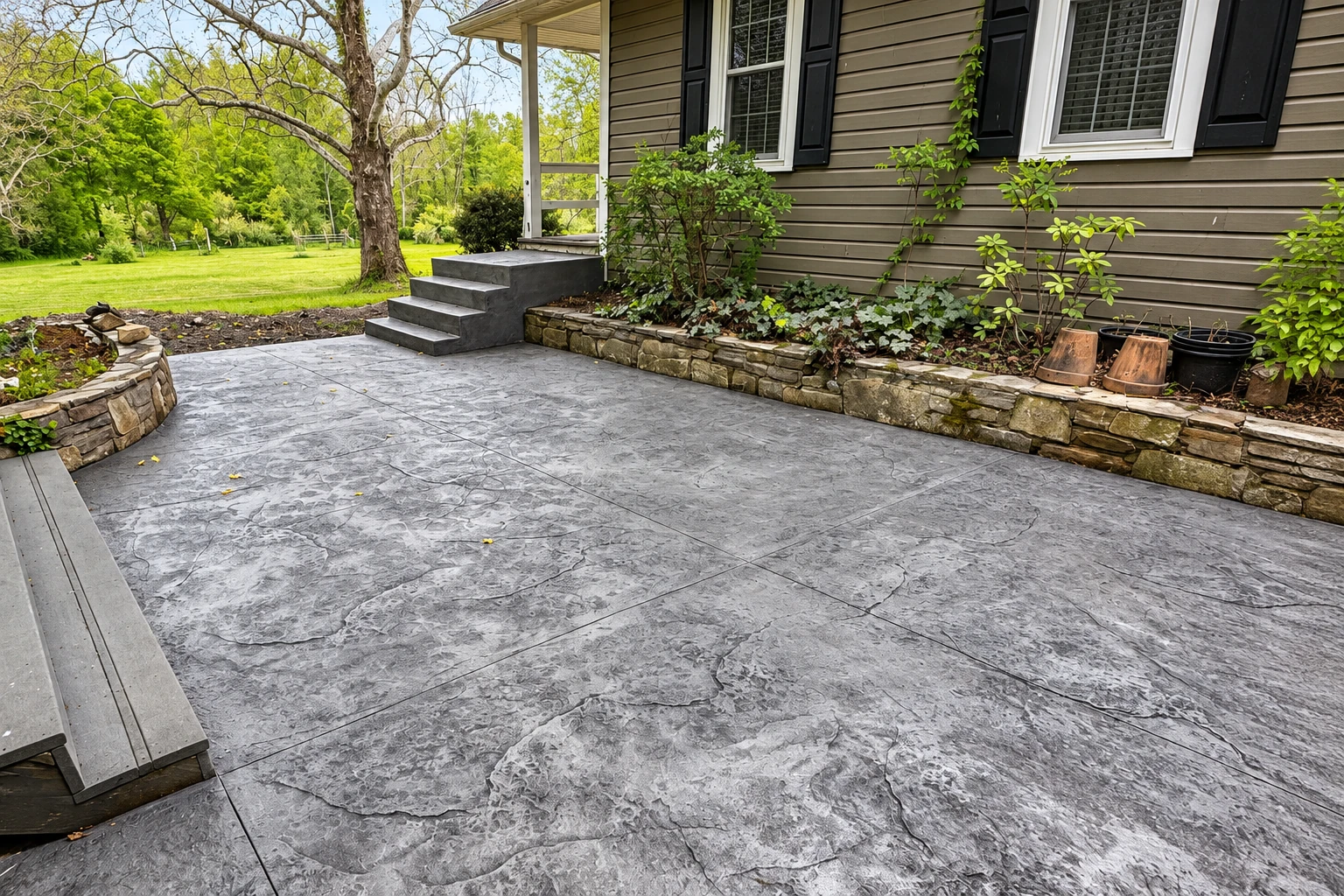
Stamped concrete services in Covina CA - a patterned slab built on a solid base
Plain gray patio or walk that's cracked and tired? We pour stamped concrete on a packed base, then color and seal it.
- Fully licensed and insured.
- Free in-person estimates.
- We respond within 1 business day.
What is stamped concrete, and is it right for your yard?
The short answer: Our stamped concrete services in Covina, CA give you a poured patio, walkway or driveway that's colored and pressed with rubber mats while it's soft, so it looks like stone, brick, wood or tile, and then sealed to protect the surface.
Most people who call us have a plain concrete patio or walk that's cracked or worn, or a bare yard they want to finish with something better than gray. The price moves with the square footage, whether old concrete has to come out, how much base work the ground needs, the pattern and how many colors you choose. The schedule turns on tear-out, any sign-off from the city and the weather on pour day. Your written estimate lists what's included, so you can see where your own job lands.
How do you know it's time for stamped concrete?
Cracked, sinking old slab
You see cracks that keep widening or a corner that's dropped below the rest. That usually means the base under it settled, and stamping over it won't help, so the old slab has to come out. The longer you wait, the more water gets under it and the more it tips.
Water pooling toward the house
After a rain, water sits on the patio or runs back toward your walls instead of away. The slab was likely poured with the wrong fall, and every storm sends more water against the house, so it's worth fixing the grade when you replace it.
Faded or cloudy stamped surface
If you already have stamped concrete and the color looks washed out or the sealer has gone white and flaky, the sealer has usually worn off or broken down. Left alone, the bare surface wears and stains faster, and it's easier to strip and reseal now than to deal with worn color later.
What our stamped concrete services include
Stamped work is still a slab underneath, so we start the same way we would for plain concrete. We dig out to firm ground and pack the subgrade, the soil and gravel the slab sits on, because a base that's only raked level settles and takes the concrete with it. We set forms with a slight fall away from the house, tie in rebar, the steel that keeps a slab from pulling apart or tipping if it cracks, and pour it as thick as its use calls for. Then we color it, press the mats while it's soft and cut control joints, shallow cuts that give the slab a place to crack where we choose instead of where it wants. Once it's cured, meaning it's had its wait to harden before anyone uses it, we put sealer down in thin coats, because a heavy coat can bubble and turn white, and we talk with you about resealing down the road. If the budget gets tight, the base is the last place I'd cut, since a finish can be touched up but a bad base means tearing the slab out.
Stamped patios usually sit beside plain concrete, and it makes sense to plan them together. If the walk out to the street is cracked or lifting, our concrete sidewalk building can match the new patio's edges and grade. Inside the garage we usually skip the pattern, because a flat, smooth slab is easier to clean and park on, and garage floor concrete is its own job with its own prep.
Color hardener
This is color worked into the top of the fresh concrete, and one color maker says it makes a denser surface that resists wear. It suits driveways and busy patios, so if you're comparing quotes, ask whether color hardener is included.
Integral color
The color is mixed into the whole batch before it's poured, so a chip or scrape shows the same color underneath. It suits patios and walks with lighter use where you want a softer, even tone.
What happens when you call about stamped concrete in Covina?
Here's how a stamped concrete job goes with us, from the first call to the walk-through. You'll talk with me about the job, and I'm there when it's poured.
- Step 01
Call and talk it through
You call and we talk about the space, what's there now and the look you're after. Then we set a time for me to come out and see it.
- Step 02
I measure and write it up
I look at the ground and where the water runs, measure, and give you a written estimate that lists what's included, from base work to sealer. If the job needs a permit, we take care of it before anything gets scheduled.
- Step 03
Pour day and walk-through
Our crew forms, pours, colors and stamps the slab, and I'm on site for the pour. When it's sealed, we walk the finished job with you before we call it done.
Stamped concrete permits and rules in Covina
Covina Building & Safety handles permits only for addresses inside the city, so the first thing we check is whether yours is under the city or the county. The city's permit handout lists flatwork, the patios, walks and slabs around a house, among jobs that don't need a building permit, but it notes that Planning Division approval is required, so we ask Planning about your project before we schedule. Driveway aprons and sidewalks at the street are different, because Covina requires an encroachment permit for work in the public right-of-way, pulled by a state licensed contractor, with inspections before work starts and when it's done. We pull that permit and set up the inspections, and since it isn't always clear where the right-of-way starts on a lot, we confirm that with the city for your address.
On jobs in Covina, West Covina and Glendora, we see a lot of older houses with original patios and walks that have settled or cracked. Afternoons here get hot, so we start pours early, because concrete that sets too fast in midday heat can end up with a weak, dusty top and leaves less time to stamp it cleanly.
Get a written estimate for your stamped concrete project
We get back to you within one business day to talk through the job, then I come out to look and measure. The estimate is free, it's done on site, and there's no obligation to go ahead.
Why Covina homeowners call Covina Concrete
The owner writes your estimate
I come out, measure and write every estimate myself, and a crew I've worked with for years does the forming, pouring and finishing. You deal with the person who answers for the job, and the people stamping your slab are used to working together.
Full time in concrete since 2013
I ran a landscape installation business first and learned concrete from the finishers I was hiring, then switched over full time in 2013. That's 13 years of driveways, patios and flatwork, and it's why I look at the yard around a slab, not just the slab.
Licensing and insurance you can ask about
We're fully licensed and insured. Bring it up at the estimate and I'll show you, because you should know who's working on your property before you sign.
Based in Covina, working the valley
We're based in Covina and work in the cities around it across the San Gabriel Valley and nearby. If you're not sure we cover your street, call and ask.
Before you pick a pattern, find out what's going under the color. Set up your estimate or call (626) 412-8840, and I'll come out and measure.
Stamped concrete questions from Covina homeowners
How much does stamped concrete cost in Covina?
Installed stamped concrete in the Los Angeles area usually costs about $15 to $30 per square foot. The low end is usually a simple pattern in one color on an open, easy-to-reach space, and the high end adds tear-out, more colors or detailed borders. Your written estimate shows what's included for your yard.
Do I need a permit for stamped concrete in Covina?
The city's list puts flatwork among jobs that don't need a building permit, but it still calls for Planning Division approval, and any part at the street needs an encroachment permit. We check which applies at your address, as covered in the rules above, before anything gets scheduled.
How often does stamped concrete need to be resealed?
One field guide advises resealing stamped concrete every 2 to 3 years. Plan for it as regular upkeep, and when we walk the finished job I'll go over what resealing involves for yours.
Who is allowed to do stamped concrete work in California?
In California, the C-8 Concrete license class covers contractors who form, pour, place, finish and install flat concrete. An unlicensed person can only take projects up to $1,000, and only when they hire no workers and need no building permits. Work in Covina's public right-of-way also needs a permit pulled by a state licensed contractor.
What causes stamped concrete to crack?
Cracks usually come from a base that settled, steel that was left out, or control joints that were cut late or skipped, not from the stamping itself. One field guide advises cutting the joints into the pattern's grout lines so they blend in, so ask any contractor where the joints will fall on your layout.
How do I get ready for a stamped concrete estimate in Covina?
Have your address, a rough size and a few photos of the area ready when you call. If you're near the West Covina line, check which city you're in, since that decides which office handles the permits.
Concrete work that pairs with stamped slabs
Concrete sidewalk building
A cracked or lifted walk next to a new stamped patio stands out, and a fresh sidewalk with matching edges ties the front of the house together.
Garage floor concrete
If the garage slab is cracked, stained or sinking, a new plain floor gives your car and tools a flat, solid surface to work on.
Call to plan your stamped concrete
We take calls from 6 AM to 11 PM on weekdays and 7 AM to 11 PM on weekends, so call (626) 412-8840 before or after work.