Concrete driveway building in Covina CA - a driveway poured and cured right
Cracked, sunken or too narrow for the cars you have now? We tear it out and pour a new driveway that drains away from the house.
- Fully licensed and insured.
- Free in-person estimates.
- We respond within 1 business day.
What does it take to build a new concrete driveway in Covina?
The short answer: Concrete driveway building in Covina means breaking out the old driveway, then forming, pouring and finishing a new slab and curing it so it holds up to the cars parked on it every day. At Covina Concrete, the pour itself is the short part. Most of the time goes into the prep before it and the curing after.
Most calls start with a driveway that's cracked, sunk in spots or too narrow for the cars you have now. The price mostly moves with the size, how much old concrete has to come out, whether the approach or sidewalk out front is part of the job, and the finish you pick. The schedule turns on whether the city has to sign off first and on the weather. If the work reaches the street, we sort out the city side at the first visit, and you see your own numbers in the written estimate once I've measured.
How do you know your driveway needs replacing?
Cracks that keep spreading
A crack that keeps getting wider or splits into a web usually means the slab has moved or water is getting under it. Patching buys a little time, but once pieces start breaking loose, replacing that section usually beats chasing cracks every year.
Sunken or uneven sections
When one section sits lower than the next, you get a lip that catches feet and tires. It doesn't level itself back out, and the longer it sits, the more of a trip hazard it becomes.
Water pooling by the garage
Puddles that sit for a day, or water that runs toward the garage door or the house, mean the driveway falls the wrong way. Every storm sends more water where you don't want it, and a new pour is the time to fix it.
How our concrete driveway building works
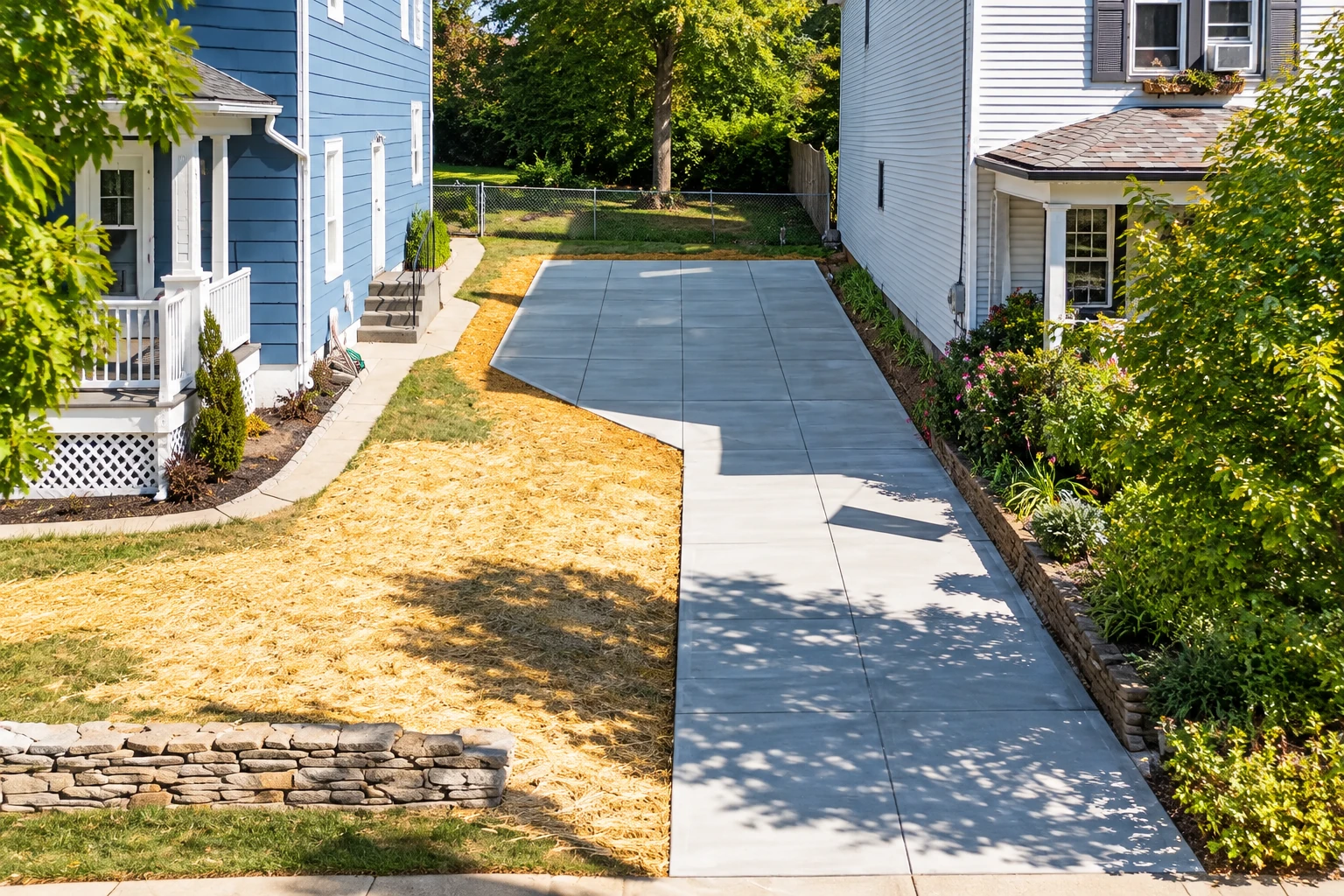
On a driveway, the first thing I check is whether the work touches the approach or the sidewalk out front, because that brings the city into it. Then our crew breaks out and hauls off the old slab, digs out and prepares the subgrade, which is the ground the new slab sits on, and sets the forms so the edges come out straight and the surface falls away from the garage and the house. We set rebar, the steel inside the slab that holds it together, then pour, finish the top and cut control joints, the straight grooves across the slab. After that it cures, which is the wait while the concrete gains strength before it takes a car, and in summer we plan the pour around the heat so the finishing and curing aren't rushed. When a budget gets tight, people want to cut the prep and keep the nice finish. I'd do it the other way around, because nobody sees the prep on pour day, and a nice finish on a bad base doesn't last.
Driveways rarely stop at the garage. Plenty of homeowners pour the back slab while we're there through our concrete patio construction, and if you'd rather have a pattern than plain gray, our stamped concrete services work on a driveway too. Both are flatwork, the flat slabs around a house, so we can plan them as one job.
Broom finish
This is the standard driveway surface, a light texture made by dragging a broom across the wet concrete so shoes and tires grip when it's wet. It suits most homeowners who want a plain, solid driveway without paying for decoration.
Stamped or colored concrete
A pattern or color pressed into the slab makes the front of the house look finished, like stone or brick. It costs more and takes more work on pour day, so it suits people who care about how the driveway looks from the street.
Wider or circular driveway
Adding a second car's width or a circular drive suits a household that's outgrown the driveway the house came with. It usually means changing the approach at the street, which adds city steps to the schedule.
What happens after you call about a new driveway in Covina?
From the first call to the final walk-through, you deal with me, and you know what's included and what the city needs before anything goes on the calendar.
- Step 01
Call and walk the job
You call, we talk through what you want, and I come out to look at the driveway and measure it. That visit is also where I check whether the work reaches the approach or the sidewalk.
- Step 02
Get your written estimate
You get a written estimate that lists what's included, so you can see exactly what you're paying for. If the job needs a permit, we take care of it before we schedule anything, and the city inspects before we start and when we finish, so we ask for that first inspection at least a week ahead.
- Step 03
Pour day and final walk
Our crew does the forming, pouring and finishing, and I'm on site the day we pour. When the work's done, we walk the driveway with you before we call the job finished.
Concrete driveway building in Covina and the city's approach rules
Covina requires a permit for any work in the public right-of-way, which is the part outside your property, like the approach that slopes down to the street and the sidewalk out front. The city's driveway approach permits cover widening, rebuilding, removing or adding an approach and building a circular driveway. Removing or adding an approach, or going circular, also needs approval from the city's Planning Division before the permit application goes in, so we put that step on the schedule early. If the work reaches past your property, or your lot has no sidewalk and the work comes close to the front property line, the city asks you to check in with its engineering staff. When a permit is needed, we pull it and set up the inspections, and for the part that stays on your lot, I find out what the city needs at the first visit.
Covina's Building and Safety office only handles addresses inside the City of Covina, not West Covina and not county addresses that carry a Covina name, so I check which office your address belongs to first. We're based in Covina and do the same driveway work in West Covina, Glendora and the other cities around it, and a lot of those calls are older single-car driveways getting widened for a second car.
Get a written estimate for your new driveway
We get back to you within one business day to set a time, and I come out to walk the job and measure it for a free, on-site estimate with no obligation. Send your address, the rough size in square feet and whether the work touches the approach or sidewalk, and I'll know what to look at before I get there.
Why Covina homeowners call Covina Concrete
I write every estimate myself
I come out, measure the job and write the estimate, and a crew I've worked with for years does the forming, pouring and finishing. I'm on site for the pour, so the person who planned your driveway is there watching it go in.
Doing concrete full time since 2013
I ran a landscape installation business first and kept hiring out the concrete, until I learned it from the finishers I was paying. I've done concrete full time since 2013, and that's why I'll tell you straight when a job doesn't need something.
Licensed to pull Covina's permits
We're fully licensed and insured. Covina only lets a state licensed contractor pull the permit for work outside your property line, so on approach work, our license is what lets the job go forward.
On a driveway, the part that matters most is the part you can't see once it's poured, so ask any contractor how they handle it. When you're ready, send us your address and a rough size or call (626) 412-8840.
Concrete driveway questions from Covina homeowners
How much does a concrete driveway cost in Covina?
A concrete driveway in the Los Angeles area usually costs about $4.10 to $10 per square foot. That's the going rate around the area, not our price, and where your job lands depends on how much old concrete comes out, whether the approach is part of it and the finish you choose. Your written estimate lists what's included, so you can compare it line by line.
What is the best time of day to pour a concrete driveway in summer?
Early morning is usually best, because hot weather is when most pouring problems show up, and wind makes heat and dry air even harder on fresh concrete. A concrete trade group advises pouring early whenever possible and getting the concrete delivered and finished quickly, so we plan summer driveway pours for an early start.
How do I make sure my new concrete driveway cures properly?
Make sure curing starts right after the pour, and ask the crew which method they're using. A concrete trade group lists a sprayed-on curing compound, seven days of continuous soaking, a wet burlap or plastic cover, or curing paper, and each one changes how you treat the slab afterward. I'll tell you which one we're using and what it means for you, like whether there's a cover you need to leave alone.
Who is allowed to build a driveway in California?
A licensed contractor should build it if the job needs a permit or uses any hired help. California's $1,000 exemption for unlicensed minor work only covers jobs that need no permit and use no hired help, so a driveway with a permit or a crew goes to a licensed contractor.
If I need a building permit too, which Covina permit comes first?
Plan for the encroachment permit, the city's permit for work outside your property, to come first or at the same time. Covina issues some building permits only once that one is issued, so we line them up together when a project needs both.
Will a new concrete driveway crack like my old one?
A new slab can still crack, because concrete shrinks as it cures, but control joints decide where most of those cracks end up. Old driveways often crack in random spots because the joints were cut late or skipped, so we lay out the joints before the pour and cut them on time. When a crack follows a joint, it sits in the groove where you hardly notice it.
Other concrete work around your driveway
Concrete patio construction
If the backyard slab is cracked or you've never had one, pouring a patio during the same project keeps all the concrete around your house matching.
Stamped concrete services
Want the driveway to look like stone or brick instead of plain gray? Stamping adds pattern and color to the same slab while it's still wet.
Get your new driveway on the calendar
We answer (626) 412-8840 seven days a week, from early morning until 11 PM, so you can call while you're standing out there looking at it.