Concrete steps construction in Covina CA - steps that sit firm on a packed base
Cracked, sinking or crumbling front steps? We build new poured or precast concrete steps on a dug-out, packed base so they sit firm.
- Fully licensed and insured.
- Free in-person estimates.
- We respond within 1 business day.
What does it take to replace concrete steps in Covina?
The short answer: Concrete steps construction in Covina means taking out tired entry steps and building new ones, either poured on site with steel inside or set in place as precast pieces, so you have a solid, even way in and out of your house.
Usually you're looking at steps that have cracked, dropped or pulled away from the door, and you want to know what replacing them involves. The price moves with how many steps you need, how wide they are, whether they're poured or precast, and how much digging it takes to get them a solid base, since extra excavation and groundwork add cost and days to poured steps. The schedule mostly turns on that groundwork and on whether your address needs a permit first, which we handle as the licensed contractor when it does. The written estimate I leave you lists what's included, so you can see where the money goes.
How can you tell your concrete steps need replacing?
Gap at the house wall
If a gap is opening between the top step and the house or the door threshold, the steps are usually settling on their own, often because they sit on loose fill instead of firm ground. Waiting lets water run into that gap and the drop at the door gets bigger, which is how people catch a toe on the way in.
Cracks across the treads
A crack running across a tread or down the face of a step usually means the ground under that spot has given way, so the concrete above it bends and snaps. Once a crack opens, water gets in and the edges start breaking off, and a patch on steps that are still moving rarely holds for long.
Steps tilting or rocking
Steps that lean to one side, tip back toward the house or rock a little when you step on them have usually lost the ground under one corner. That's a fall waiting to happen, and the longer they move, the more they pull on whatever they're attached to.
How we build new concrete steps
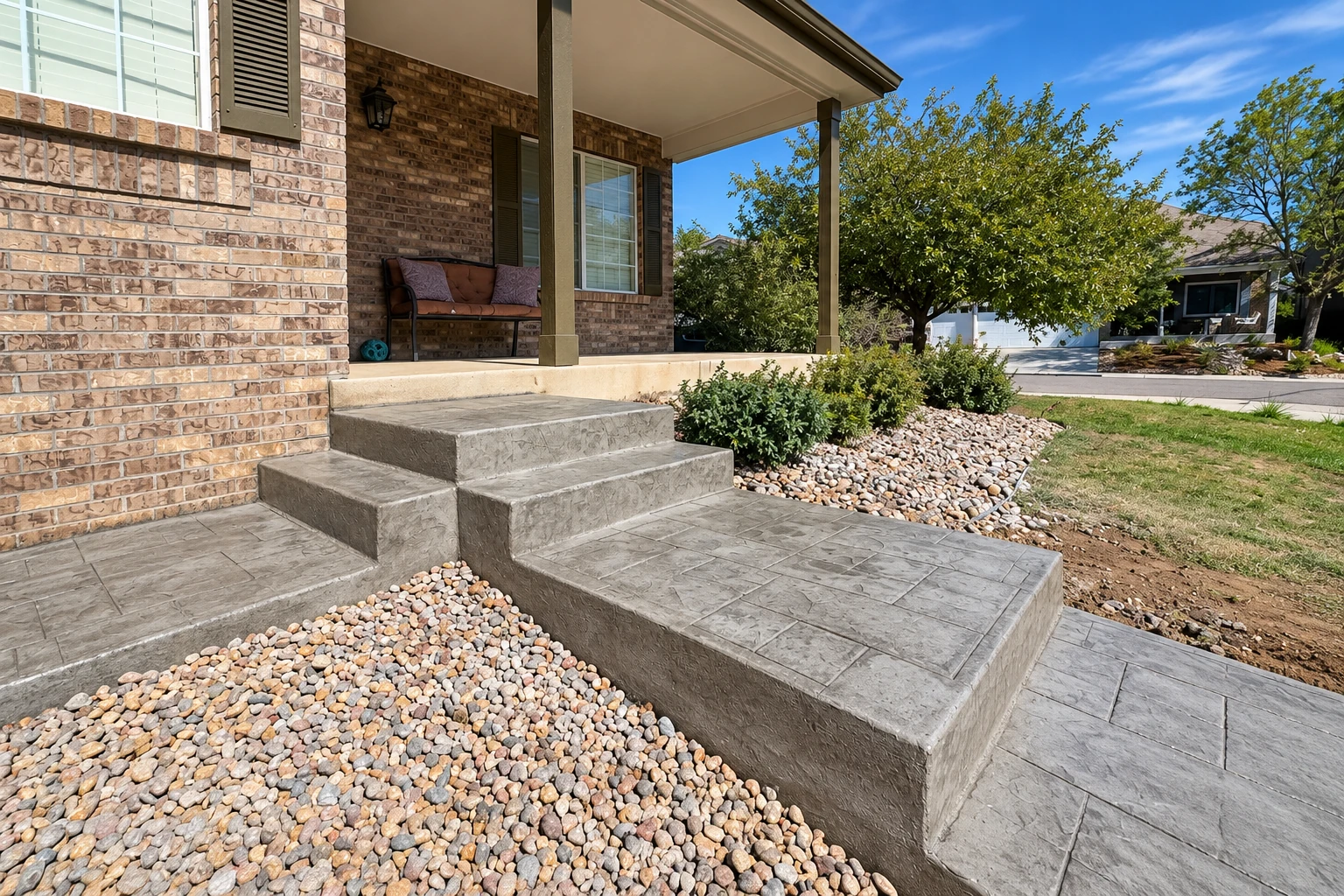
I start by looking hard at what the new steps will rest on, because loose fill under a set of steps is trouble, and by helping you pick poured or precast based on the size, the shape and how hard it is to get pieces into place. Steps can sit on the ground, connect to a landing or the house foundation, or span between supports, and that choice decides how much steel goes in and what kind of footing they need. We break out the old steps and dig past the loose dirt down to the subgrade, the ground the steps actually sit on, then pack a base so the new steps don't settle the way the old ones did. For poured steps our crew builds the forms, sets rebar, the steel bars that hold the concrete together if it cracks, then pours and finishes the treads, and for precast we set the pieces level on that same packed base.
Steps often come up as part of bigger work. When you're adding a room or rebuilding a porch, we plan the steps alongside the foundation installation so they're tied in from the start instead of butted up against it later, and when an addition sits on a slab, slab foundation building and the steps up to it can go in on the same schedule.
Poured on site
Poured steps cost more, but they can be built to nearly any width, height or shape, so they suit a wide entry, a curved run or steps that wrap a corner. They come out as one solid piece with the steel inside, tied to the ground or landing we've chosen for them.
Precast steps
Precast steps arrive as hollow units that go together quickly, so they suit a plain, standard-size entry where there's room to bring the pieces in. Their price follows the height and width you need, which makes them a good fit for a short, narrow set.
What happens when you call about concrete steps in Covina?
From the first call to the final walk-through, you talk to me. Here's how a steps job runs, and where the city's rules on work hours and inspections fit in.
- Step 01
Call and talk it through
You call, and we talk through what's wrong with the steps you have and what you'd like instead. Then we set a time for me to come out.
- Step 02
I measure and write it up
I look at the entry, check what the steps will sit on and take measurements. You get a written estimate that lists what's included, so you can compare it line by line with any other bid.
- Step 03
Permit first, then the calendar
If the job needs a permit, we take care of it before anything gets scheduled. When the city inspects, an adult 18 or older has to be home to let the inspector in, pets need to be kept away from the work, and the inspection happens before anything gets covered.
- Step 04
Pour day and the walk-through
I'm on site when our crew pours, and we work inside the city's hours, since Covina makes construction work unlawful between 8 p.m. and 7 a.m., and on Sundays and holidays, when it disturbs the neighbors. When it's finished, we walk the steps with you before we call the job done.
Covina permits and city limits for concrete steps
Before we plan permits into a steps job, I check whether your address is in the City of Covina or under the county, because Covina's Building & Safety Division can only take applications for addresses inside city limits. That leaves out West Covina and any Covina address that falls under the county, which go to a different office. In the city, Planning Approval is required before a permit is submitted for exterior changes and new structures, and the city's list names those but not concrete steps. So whether your steps need a permit isn't something I'll guess at. We confirm it with the city for your address and pull the permit as the licensed contractor when one is needed. The city asks for a site plan on every project, whatever its size, so a simple drawing of your lot showing the house and the entry gets things moving.
We're based in Covina and build steps across the San Gabriel Valley and nearby, and if you're not sure we cover your area, call and ask. A lot of the entry steps we replace were set on fill and never tied to anything, and we find the same thing on jobs in Baldwin Park and Glendora, so the base gets the same attention wherever the house is.
Get a written estimate for your new concrete steps
We get back to you within one business day to talk through the job and set a time for me to come out and measure. The estimate is free, on site and comes with no obligation, and it helps to have the number of steps, a rough width and a few photos of the entry ready.
Why Covina homeowners call Covina Concrete
The owner measures and prices it
I come out to look at your steps and write the estimate myself, and I'm back on site the day our crew pours. The person who told you how the base would be built is standing there when it goes in.
Concrete full time since 2013
I ran a landscape installation business first, learned concrete from the finishers I was hiring, and switched over full time in 2013. The forming, pouring and finishing are done by a crew I've worked with for years, so nobody's learning on your entry.
Fully licensed and insured in California
We're fully licensed and insured, and you can check any contractor who bids your job with the state licensing board. The board describes a concrete contractor as one who forms, pours, places and finishes concrete, which covers the whole of a steps job.
On a set of steps, what matters most is what's under them, and it's the one part you won't see again after pour day. Every job is satisfaction guaranteed. When you're ready, send us the details or call (626) 412-8840.
Concrete steps questions from Covina homeowners
How much do new concrete steps cost in Covina?
Pouring concrete steps usually costs about $200 to $500 per step across the US, going by a national cost guide from late 2025, so treat it as a ballpark rather than a Covina quote. Precast steps generally come in lower because they're hollow and easier to put together, while digging and groundwork push poured steps up. Your written estimate gives the number for your entry.
Should I get precast or poured concrete steps?
Go with poured if your entry is an unusual size or shape, and precast if it's a plain, standard set with room to bring the pieces in. One precast maker's guide even suggests poured steps where tight access makes moving or lifting precast pieces into position impractical. I'll tell you which fits once I've seen the entry.
How long do concrete steps last?
Concrete steps last about 30 to 40 years with proper care and upkeep. That lifespan leans on the care, so plan on looking after them over the years, keeping water draining away and dealing with small cracks before they spread.
How long does new concrete take to cure before I can use my steps?
General trade guidance for concrete says curing starts as soon as finishing is done and lasts at least 3 days. During that time the concrete is kept from drying out under wet burlap and plastic sheeting or with a liquid curing compound, because concrete that dries too fast ends up with a weak, dusty top. We'll tell you at the walk-through when the steps are ready for foot traffic.
Does someone building concrete steps in California need a contractor license?
Usually, yes. California's exemption for unlicensed minor work stops at $1,000, and it only applies when the job needs no permit and the person has no employees on it. Ask anyone who bids your steps for their license and check it with the state board.
What is the best finish for outdoor concrete steps?
Outdoor steps need a finish with grip, so they shouldn't be troweled to a smooth, polished surface that turns slick when it's wet. We usually give the treads a broom finish, a fine texture dragged into the surface with a broom before it sets, so your feet have something to catch on.
Related concrete work for steps and entries
Slab foundation building
If your addition or new room sits on a slab, we can pour that slab and plan the steps up to its door as one job.
Foundation installation
When the porch or wall behind your steps has moved, the fix may start lower, with a new foundation under that part of the house.
Get your concrete steps measured and priced
We answer (626) 412-8840 from early morning until 11 PM, weekends included, so you can call after work or send the form tonight.